Key Statistics
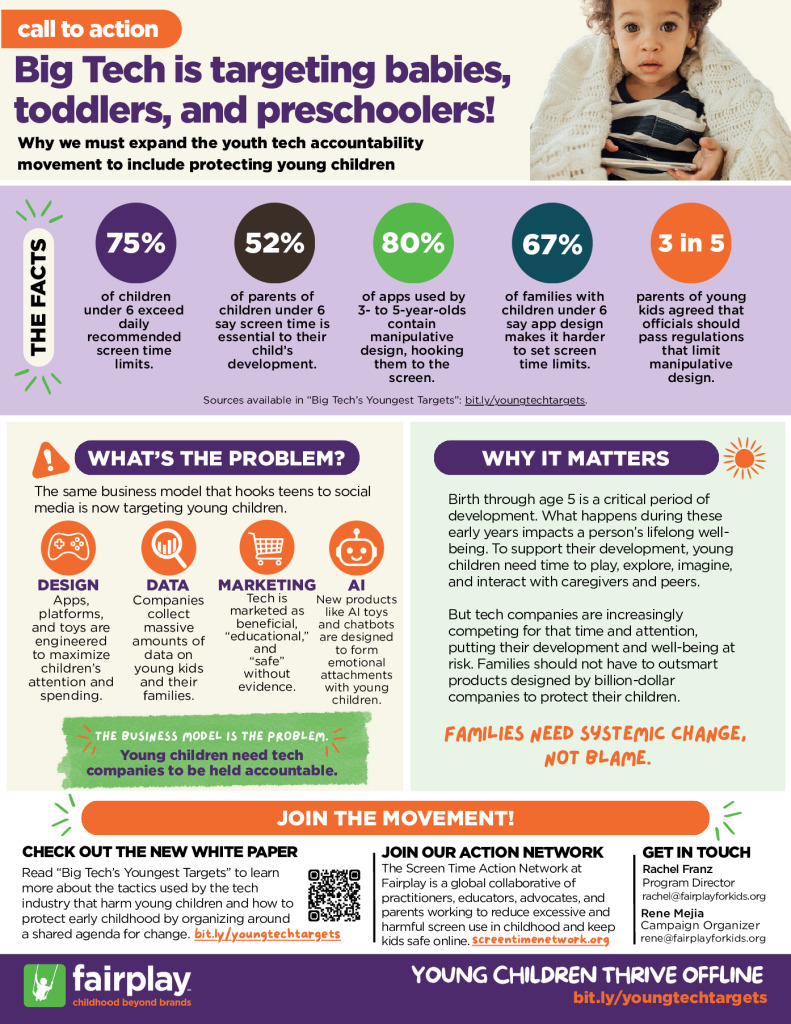
- Three out of four families (75%) with children ages 0 to 2, and 79% of families with children ages 2 to 6, exceed recommended screen time limits every day. A large majority of parents also say their babies (70%), toddlers (74%), and preschoolers (72%) use YouTube or YouTube Kids daily. (Fairplay, “Hooked from Birth”, 2025)
- 80% of apps played by children ages 3 to 5 contain manipulative design features that push them to keep playing or make purchases. (Radesky et al., “Prevalence and Characteristics of Manipulative Design in Mobile Applications Used by Children,” JAMA Network Open, June 2022)
- 67% of families with children under 6 agree that the way apps are designed makes it harder to set screen time limits. (Fairplay, “Hooked from Birth”, 2025)
- By the time they’re 2 years old, 40 percent of children have their own tablet; by age 4, that percentage goes up to more than half (58 percent). By age 8, nearly 1 in 4 children have their own cell phone. Overall, just over half (51 percent) of children age 8 and younger have some sort of mobile device. And on average, they spend nearly two and a half hours per day using screen media: TV or video viewing, gaming, video chatting, and more. For kids in the 5-8 age group, that figure jumps up to almost three and a half hours daily. 2025-common-sense-census-web-2.pdf
- 31 percent of 8-year-olds owned a smartphone, nearly tripling from 2015. (Statista, Published October 14, 2022)
- Of 2,167 UK five- to 16-year-olds, said 53% of youngsters owned mobile phones by around the age of seven. by age 11, 90% had their own device, and phone ownership was “almost universal” once children were in secondary school. 57% of all the children surveyed said they always slept with their phone by their bed. (CHILDWISE Monitor report 2020)
- More than a third of parents with a child under 12 say their child began interacting with a smartphone before the age of 5. In 2020, nearly 1 in 5 parents (17 percent) of a child 11 or younger had given their child their own phone. (Pew Research Center, July 28, 2020).
- The number of sexts children attempted to send (including girls as young as 6) had risen 183% during the lockdown.(SafeToNet, June 24, 2020).1 in 5 Of girls (aged 13-17) agreed that they have shared their own nudes. 1 in 10 Of boys (aged 13-17) reported that they have shared their own nudes. 40% Agreed that “it’s normal for people my age to share nudes with each other (Thorn, “Self-Generated Child Sexual Abuse Material: Attitudes and Experiences” August 2020)
- Almost half (46 per cent) of young people aged 12-16 feel they’re addicted to their smartphones (Digital Wellbeing 2020, The Cybersmile Foundation)New data reveals that self-generated imagery now accounts for nearly a third of web pages featuring sexual images of children actioned by the Internet Watch Foundation (IWF). More than three quarters of the self-generated material – be it images or videos -feature 11 to 13-year-old children, of which the majority are girls. (Internet Watch Foundation, Jan. 15, 2020)
- By age 11, a majority (53%) of kids have their own smartphone, and by 12 more than two-thirds (69%) do. (Common Sense Media, 2019)
- 2018
- 95% of teens now report they have a smartphone or access to one. These mobile connections are in turn fueling more-persistent online activities: 45% of teens now say they are online on a near-constant basis. (Teens, Social Media and Technology, Pew Research Center 2018)
- Among 13-17 year olds in the United States, a 2018 study (Social Media, Social Life) conducted by Common Sense Media in 2018 found:Teens overwhelmingly choose Snapchat (41 %) as their main social media site, followed by Instagram (22%) and Facebook (15%)
- Social media use has increased dramatically by teens. 89% have a smart phone (compared to 41% in 2012), and 70% of teens are on social media multiple times a day (compared to 34% in 2012).
- 54% of teens report that if parents knew what actually happened on social media, they’d be a lot more worried about it.
- 1 in 5 teens report says they check notifications while driving at least sometimes. 44% say they “never” do. (Distracted driving)
- Children are accessing pornography via mobile devices.PornHub said its users watched 4.6 billion hours of pornography in 2016, 61% via smartphone and 11% via tablet.
- According to the Library of Congress, in the UK:.
- 43 percent of nine- to 12-year-olds have a social media profile
- One in three are on Facebook despite the 13-year-old age limit.
- A quarter of those kids on Facebook never touch the privacy restrictions on their profile, and a fifth of them publicly display their address and/or phone number.
- In regard to Victim ID Theft, Carnegie Mellon CyLabs says children are over 50 times as likely to have their social security number used by another person.
- One in 40 families has a child who is a victim of identity theft, according to the Identity Theft Assistance Center and the Javelin Strategy & Research Group, and that figure is on the rise
(Comparitech. “Protecting Children’s Privacy – A Guide for Parents, Carers and Educators.” April 20, 2016). Nearly 3,000 people aged 18 to 54 were surveyed and one in 10 respondents reported that someone had posted online or sent to others nude or seminude pictures of them without their permission and 9.6% reported that someone threatened to post such images or to send them to others (Technology-Facilitated Sexual Violence Victimization: Results From an Online Survey of Australian Adults, October, 2016)
- Mobile porn is expected to reach $2.8 billion by 2015.
- By 2017, 250m people are expected to be accessing mobile adult content from their phones or tablets, an increase of more than 30% from 2013. Juniper Research, “250 Million to Access Adult Content on their Mobile or Tablet by 2017, Juniper Report Finds.” Sept. 2013. http://www.juniperresearch.com/viewpressrelease.php?id=628&pr=401 (accessed Dec. 29, 2015)
- 37% of 3 and 4 year olds use their parent’s tablets and smartphones as do 87% of 5 to 7 year olds. (http://www.familysafemedia.com/pornography_statistics.html – accessed June 6, 2014).
- Sexting behaviors are significantly associated with consuming pornography. Van Ouytsel J; Ponnet K; Walrave M. “The associations between adolescents’ consumption of pornography and music videos and their sexting behavior,” Cyberpsychol Behav Soc Netw. 2014 Dec; 17(12): 722-8, at http://online.liebertpub.com/doi/full/10.1089/cyber.2014.0365
- A third of 11 to 14 year olds have watched porn on a mobile device. Jonathan Blake, “Mobile porn access ‘damaging’ children and teenagers,” BBC Newsbeat, 2/11/14, at http://www.pewinternet.org/2010/04/20/teens-and-mobile-phones/
- About half of 15 to 17 year olds have accessed pornography on a smartphone or tablet. Jonathan Blake, “Mobile porn access ‘damaging’ children and teenagers,” BBC Newsbeat, 2/11/14, at http://www.bbc.co.uk/newsbeat/26122390
- 21% of teen Facebook users share their personal cell phone number (PEW Research Center, 2013)
- One-third of youth ages 11 to 17 have their own cell phones today; it is expected that half will have them within the next two years (English, Bella. “The Secret Life of Boys: Pornography is a Mouse Click Away, and Kids Are Being Exposed To It In Ever-Increasing Numbers.” http://www.boston.com/ae/media…12/secret_life_of_boys/)